The University of Sarajevo (UNSA) is a dynamic and globally engaged institution that warmly welcomes academic and administrative staff from around the world. Whether you are joining us for teaching, training, research, or professional development, UNSA provides diverse opportunities to enrich your expertise, build lasting partnerships, and contribute to our vibrant international community.
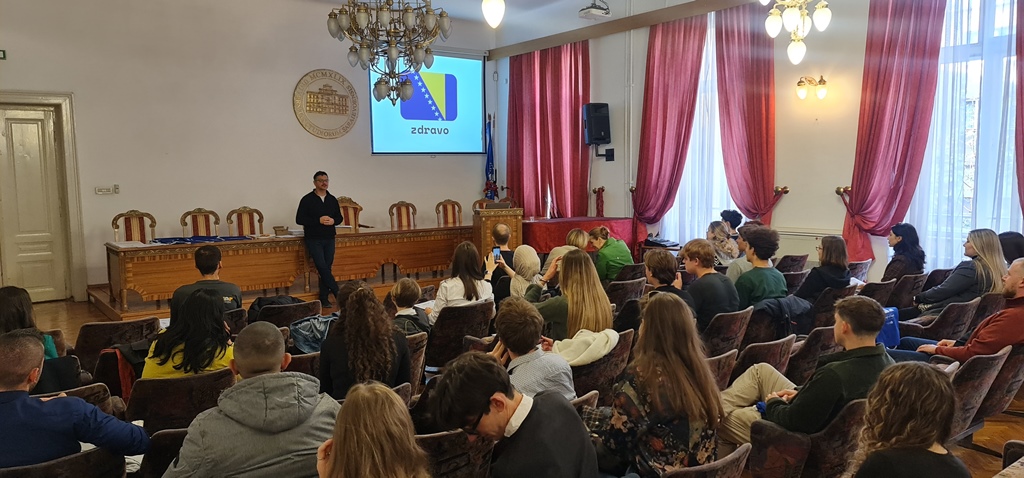
HOW TO COME TO THE UNIVERSITY OF SARAJEVO (UNSA)?
At the University of Sarajevo (UNSA), international staff can join us in various ways:
As Teaching Staff
If you are coming to deliver lectures, workshops, or share expertise, you can apply through Erasmus+ Teaching Mobility, CEEPUS, or bilateral agreements.
– TEACHING OPTIONS
Incoming teaching staff can deliver lectures, seminars, or workshops at the University of Sarajevo (UNSA), hosted by the relevant faculty or department. Once nominated to us, we connect you with your potential host with whom you will discuss your mobility dates and activities.
– TEACHING + TRAINING
Staff visits may combine teaching with training activities, allowing participants to both share expertise and gain new skills. Within Erasmus+ program, you can have 4 hours of teaching and 4 hours of training.
– STAFF TEACHING WEEK
Certain faculties organize thematic staff weeks, offering opportunities to teach and network with peers across disciplines. We inform all of our partners about available possibilities on the official UNSA website.
– CEEPUS
Staff mobility is also possible through the CEEPUS program, based on UNSA’s active networks and agreements. More at: https://www.ceepus.info/.
As Training Staff
If your focus is professional development, you can apply for Erasmus+ Training Mobility, including seminars, job-shadowing, or workshops.
– UNSA INTERNATIONAL STAFF TRAINING WEEK
UNSA International Relations Office hosts an annual International Staff Training Week, bringing together colleagues from partner universities for workshops, best-practice sharing, and networking. We have two staff weeks, spring and autumn edition. We inform all of our partners about available possibilities on the official website.
– INDIVIDUAL MOBILITY (JOB-SHADOWING)
Staff may arrange individual job-shadowing visits with UNSA colleagues to exchange knowledge and observe daily practices. Sometimes language barrier can be an obstacle to find similar department, but make sure to check first.
– RESEARCH
Visiting researchers can collaborate on joint projects, publications, or research activities with UNSA’s academic staff. Our Research Office coordinates research projects and can help you in finding options to collaborate.
– THROUGH DIFFERENT INTERNATIONAL PROJECTS
The University of Sarajevo has the opportunity to participate in various international educational and research programs by preparing project applications as a project coordinator or consortium partner. Most often, these programs (projects) are financed from EU funds (Erasmus+, Horizon2020/Europe, CEEPUS, IPA, Cost, etc.). If you want to include the University of Sarajevo in your project proposal(s) for upcoming calls, you can check your options:
Other Programs
Staff mobility is also possible through bilateral agreements, EUPeace, and other international cooperation programs.
ELIGIBILITY
To be eligible, staff must be officially nominated by their home institution. Nominations are accepted only from partner universities with which UNSA has signed Erasmus+ or bilateral agreements, or participates in different networks or alliance. Nominations outside partnerships ar epossible, but must be previosuly discussed to avoid any potential administrative obstacles.
STEP 1: NOMINATION
The first step is nomination by your home institution. Nominations are submitted by the home coordinator through the UNSA online nomination form and should include the staff member’s name, position, field, and email address. Staff nomination must be received minimum two (2) months prior the planned mobility. If coming for teaching, mobility dates must fall under approved teaching dates (October – December and March to May).
Please note: If you are applying to an open mobility call at your home institution and are exploring available options, kindly mention in your email that you are currently in the application process and that your mobility has not yet been confirmed.
STEP 2: APPLICATION
Once the nomination is received, the UNSA International Relations Office will contact the nominee with instructions for the application by sending an application form to complete. Please fill it in carefully, as the information provided will help us identify a suitable host institution.
STEP 3: EVALUATION
Your application form should include a draft teaching/training program, description of planned activities and proposed dates. This information is essential for evaluating the application and confirming the mobility plan.
STEP 4: CONFIRMATION
Once your mobility is approved, you will receive a welcome email from UNSA containing confirmation of acceptance, instructions regarding the required documents, and practical information to help you prepare for your mobility.
DRAFTING THE TEACHING/TRAINING AGREEMENT
A Mobility Agreement (Teaching or Training) must be drafted and approved by both the home and host institutions before arrival, in accordance with the regulations of the mobility programme (e.g. Erasmus+). You will essentially copy and paste the information already approved in the Application Form and make adjustments where necessary, in line with any agreed changes.
Filling in the “receiving institution” part:
| Name | UNIVERSITY OF SARAJEVO | Faculty/department | Add the name of the host member unit at the UNSA (i.e. Faculty of Philosophy / History) |
| Erasmus code | BA SARAJEV01 | ||
| Address | Enter the address of the host member unit (check here) | Country / Country code | Bosnia and Herzegovina / BiH |
| Contact person and position | Enter the name of the facutly coordinator (check here) | Contact person email / phone | Enter the data of the facutly coordinator (check here) |
At the signing page, add the name of the Faculty coordinator who signs your mobility agreement (check here)
TRAVEL ARRANGEMENTS
Travel is arranged by the participant in coordination with their home university, in accordance with the grant and mobility rules. Most likely, your arrival will be by plane, so please make sure to check available flight options. For more information, please consult our Welcome to Sarajevo guide (.pdf), where you can find details about travel options to Sarajevo.
VISA/RESIDENCE PERMIT (if needed)
Depending on your nationality (according to your passport) and the length of your stay, you may require a visa or a residence permit. Support and guidance can be provided by UNSA’s host department. For many participants who already hold a residence permit in an EU Member State and are staying for a short mobility period, entry and stay of up to 30 days may be possible. However, these conditions should always be verified in advance to ensure there are no obstacles.
HEALTH AND TRAVEL INSURANCE
Incoming staff must have valid health and travel insurance covering the entire stay in Bosnia and Herzegovina.
ACCOMODATION OPTIONS IN SARAJEVO
UNSA does not have student nor staff dormitories. However, various accommodation options are available, including hotels, hostels, and private apartments. UNSA can provide guidance and suggestions. You can check our Welcome to Sarajevo guide (.pdf) to check accommodation options to Sarajevo.
ORIENTATION INFORMATION
Depending on the agenda and the program, all incoming staff receive orientation support, practical information, and the opportunity to join cultural and networking activities during their stay. You can check our Welcome to Sarajevo guide (.pdf) to make your stay in Sarajevo comfortable.
START OF MOBILITY
Upon arrival, staff complete administrative formalities, and begin their teaching, training, or research activities. This phase is also an opportunity to experience Sarajevo’s rich cultural life and strengthen academic networks.
LIVING IN SARAJEVO
We’ve gathered some useful advice to help make your everyday life in Sarajevo easier—from getting around the city and handling money, to local customs and where to find good (and cheap!) food.
SCANAJEVO – YOUR PERSONALIZED MAP
Our office has created a specialized Google Map – SCANAJEVO. Easy to use and navigate, SCANAJEVO helps students and staff easily find UNSA units, key locations to visit, places to eat, museums, sports facilities, offices for administrative procedures, or simply the best spots for taking photos.
BEFORE DEPARTURE
At the end of the mobility, staff usually needs to complete the required documentation, such as the Confirmation of Stay (signed by the direct host coordinator), and are encouraged to share feedback with the International Relations Office.